

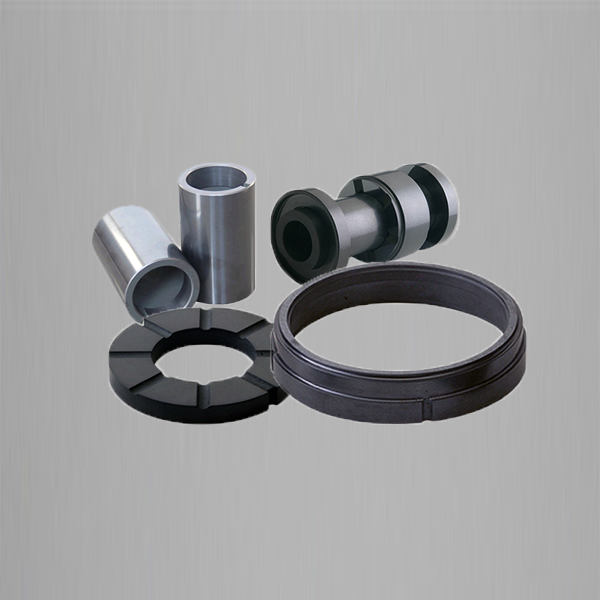
Renowned for over 25 years, silicon carbide is one of the most sought-after high-performance tribomaterials. Its outstanding features make it the top choice for various industrial applications. Unlock the full potential of your mechanical seal parts with Junty's exceptional silicon carbide (SiC) solutions.
Why Choose Silicon Carbide?
- Exceptional Corrosion Resistance: Silicon carbide boasts excellent resistance against corrosive environments, ensuring durability in challenging conditions.
- Superior Wear and Abrasion Resistance: Experience unparalleled longevity with silicon carbide's remarkable wear and abrasion resistance, extending the lifespan of your components.
- Low Coefficients of Friction and Thermal Expansion: SiC minimizes friction and thermal expansion, optimizing performance and efficiency in diverse applications.
- High Thermal Conductivity: Benefit from efficient heat dissipation with silicon carbide's high thermal conductivity, enhancing the overall reliability of your systems.
- Hardness Beyond Tungsten Carbide: Silicon carbide surpasses tungsten carbide in hardness, ensuring robust and enduring performance.
Tailored Solutions for Your Applications:
At Junty, we understand that each application is unique. That's why our silicon carbide solutions are designed to be adaptable and versatile. Whether you seek cost-effectiveness, chemical resistance, or enhanced performance, Junty has the right silicon carbide grade for you.
- Reaction Bonded Silicon Carbide (RB SiC) is a very cost-effective material that has good chemical resistance and excellent wear properties.
- Sintered Silicon Carbide (SSiC) is the most resistant to chemically hostile fluids and is best for high temperature applications because it contains no free silicon.
- A mixture of silicon carbide and free graphite is known as graphite-loaded silicon carbide. To enhance the tribological performance and lubricity of RB SiC (RB SiC + C) or SSiC (SSiC + C), graphite is added to create a composite.
Experience the Junty Advantage:
- Expertise: Over two decades of expertise in delivering high-performance materials.
- Innovation: Cutting-edge solutions crafted to meet and exceed industry standards.
- Customization: Tailor-made silicon carbide solutions to suit your specific needs.
Choose Junty for silicon carbide excellence—where durability meets innovation. Contact us today to elevate your application's performance.
| Parameter | Unit | RB SiC | SSiC |
| Density | g/cm3 | 3.0-3.05 | 3.10 |
| Free Silicon Content | % | 12% | – |
| Crystal Size | μm | 8-20 | 5-7 |
| Hardness | Rockwell | HRA 90 | >HRA 93 |
| Compressive Strength | Mpa | 2700 | 3000 |
| psi | 391,500 | 435,000 | |
| Flexural Strength | Mpa | 400 | 400 |
| psi | 58,000 | 58,000 | |
| Fracture Toughness | Mpa.m1/2 | 4.3 | 4.5 |
| Elastic Modulous | Gpa | 390 | 410 |
| psi | 57×106 | 59×106 | |
| Poisson's Ratio | / | 0.15 | 0.15 |
| Thermal Expansion Coefficient | 1×10⁻⁶/K | 4.3 | 4.3 |
| Parameter | Unit | RB SiC + C | SSiC + C |
| Density | g/cm3 | 2.70 | 2.85 |
| Free Silicon Content | % | – | – |
| Crystal Size | μm | – | – |
| Hardness | Rockwell | HRA 82 | HRA 85 |
| Compressive Strength | Mpa | 1500 | 2000 |
| psi | 217,500 | 290,000 | |
| Flexural Strength | Mpa | 200 | 300 |
| psi | 29,000 | 435,000 | |
| Fracture Toughness | Mpa.m1/2 | – | – |
| Elastic Modulous | Gpa | 250 | 320 |
| psi | 36.3×10⁶ | 46.4×10⁶ | |
| Poisson's Ratio | / | – | – |
| Thermal Expansion Coefficient | 1×10⁻⁶/K | – | – |