

In industrial applications, finding a reliable and efficient sealing solution is of utmost importance. At Junty, we take pride in introducing our product – the containment shell. Designed with innovation and excellence, our containment shells provide a separation component between the external and internal magnets, ensuring leakage-free sealing without mechanical seals. Join us as we delve into the world of containment shells and unveil their numerous benefits across industries and applications.
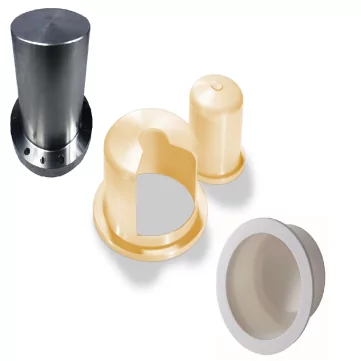
The Role of Containment Shells in Sealing Excellence
The containment shell serves a critical function in sealing operations. Acting as a barrier between the external magnet (drive magnet) connected to the motor and the internal magnet (driven magnet) attached to the impeller, it prevents leakage from occurring. This seal-less solution eliminates the risk of mechanical seal failure over time, providing a reliable and long-lasting sealing alternative for various applications.
No Heat Generation, Enhanced Efficiency
One of the notable advantages of Junty’s containment shells is their ability to reduce heat generation caused by magnetic induction. Unlike commonly used metals, the zirconia ceramic material we employ does not produce heat when exposed to a changing magnetic field. This unique characteristic translates into improved efficiency, minimizing efficiency loss, and mitigating the risk of overheating failures.
Unmatched Mechanical Strength and Flexibility
Our choice to utilize zirconia ceramic material for our containment shells stems from its exceptional mechanical properties. With high mechanical strength and good flexibility, this material effectively withstands demanding environments and rigorous applications. Our containment shells offer reliable sealing solutions across various industries, from chemicals and hazardous liquids to cryogenics and crystallizing fluids.
Corrosion-Resistant for Longevity
In corrosive environments, having a sealing solution that can withstand the test of time is crucial. Junty’s containment shells, made from zirconia ceramic material, exhibit excellent corrosion resistance properties. They can endure harsh chemical interactions and resist the degradation commonly experienced by other materials. This durability ensures that our containment shells maintain their sealing efficiency, even in the harshest of conditions.
Conclusion:
Junty’s containment shells emerge as a cutting-edge solution when achieving reliable, leakage-free sealing in industrial applications. By eliminating the need for mechanical seals and utilizing zirconia ceramic material, we offer a superior alternative that exhibits no heat generation, high mechanical strength, flexibility, and corrosion resistance. Trust Junty to provide you with innovative, efficient, and long-lasting containment shells that excel across various industries, applications, and environments. Experience the power of Junty and enhance the reliability of your sealing operations today.
Share This Post With Others!
Related Posts
 Enhance Water Pump Performance with Versatile Mechanical Seal Rings from JuntyAugust 30, 2024
 Trust Junty for All of Your Thrust Disc and Thrust Washer NeedsAugust 29, 2024
 Your Trusted Source for High-Quality Mechanical Seal PartsAugust 28, 2024
 Carbon Graphite Solutions Boasting Resin Bonding, Resin Impregnating, and Metal ImpregnatingAugust 27, 2024